History, Nature, Food & Wines in Bourgogne-Franche-Comté
Bourgogne-Franche-Comté comprises the former regions of Bourgogne and Franche-Comté, merged into a large region in eastern France, near the French capital, Paris, and the Alps. The area comprises the departments of Côte-d'Or, Doubs, Jura, Nièvre, Saône-et-Loire, Haute-Saône, Territoire de Belfort and Yonne.
Historic Towns and Scenic Landscapes
Bourgogne-Franche-Comté feels like a tapestry woven from history, nature, and human effort. This large region, formed by merging Burgundy and Franche-Comté in 2016, features fertile plains, gentle hills, and mountains, providing a feast for the senses and a window into French culture.
Vineyards & World-Renowned Wines
When you step into Burgundy, you enter a realm steeped in tradition. The vineyards cover the landscape, whispering tales of ancient viticulture and world-renowned wines.
Here, in Bourgogne-Franche-Comté, Pinot Noir and Chardonnay grapes reach their ultimate expression, yielding classic AOC appellations such as Chablis, Nuits-Saint-Georges, and Meursault, among many others.
Wander through villages such as Beaune, with its medieval heart and famous Hospices de Beaune, or explore the opulent Palace of the Dukes of Burgundy in Dijon, a testament to the region's past.
Romanesque Abbeys & Pilgrimage Routes
Beyond the vine-covered hills, history comes alive in grand abbeys like Fontenay and the Basilica of Sainte-Marie-Madeleine in Vézelay, both echoing tales of faith and pilgrimage.
Explore the region's spirit further at the Château de Sully, a fortress that once sheltered Anne Boleyn, or follow the trail of Joan of Arc in Domrémy-la-Pucelle, her childhood home.
The Wonders of Franche-Comté
As you cross the threshold into Franche-Comté, you'll find yourself in a different world, where lush valleys, dense forests, and the Jura Mountains create a postcard setting perfect for outdoor enthusiasts.
You can hike through the Parc Naturel Régional du Haut-Jura, kayak on the Lac de Saint-Point, or ski down the slopes of the Métabief resort.
Industrial Heritage and Modern Innovation
But Franche-Comté offers more than just scenic beauty. Its industrial legacy is a key part of its character. Cities such as Belfort, renowned for the famous Peugeot car factory, and Besançon, known for centuries of precise watchmaking, are vibrant centres of modern industry.
You can visit the captivating Musées des Beaux-Arts in Besançon or learn about time at the history of horology at the Musée du Temps et de l'Horlogerie.
Regional Cuisine & Specialities
Enjoy escargots à la Bourguignonne, plump snails cooked in garlic butter; the region's cheeses, like Époisses and Comté, offer bold flavours that pair perfectly with local wines, usually red. Explore the culinary delights of Franche-Comté, and you'll discover many classic dishes.
Treat your taste buds to Saucisse de Morteau, a smoked sausage with a smoky-garlicky kick. Try the speciality Poulet au Vin Jaune, a chicken dish made with the region's renowned vin jaune, a complex white wine aged for years. Be sure to taste the iconic Comté cheese, produced using traditional methods for centuries, and enjoy pairing it with a regional wine.
Hidden Villages Beyond Popular Routes
While the attractions mentioned are interesting, the region encourages exploring beyond the main paths. You might visit the medieval town of Salins-les-Bains, known for its salt industry and thermal baths.
Alternatively, stroll through the charming villages along the Route des Vins du Jura, each featuring distinctive architecture and local flavour.
Climate in Bourgogne-Franche-Comté
The Bourgogne-Franche-Comté region has a semi-continental climate with distinct seasons. Winters are cold and long, with January averages of 1-2.5°C in the plains, while summers are warm and sunny, with July temperatures of 19-20.5°C and frequent heatwaves. Annual rainfall of 800-900 mm is evenly distributed, with drier summers.
The region’s diverse terrain creates varied microclimates: the Val de Saône and Côte viticole plains enjoy a southern influence, making them ideal for viticulture, while the Jura and Morvan mountains have cooler summers and higher rainfall.
Seasonal Beauty & Year-Round Exploration
The beauty of Bourgogne-Franche-Comté lies in its year-round allure. Spring paints the vineyards in vibrant greens, summer invites outdoor adventures, autumn ignites the landscape with fiery red colours, and winter transforms the region into a snow-laden wonderland.
Key Facts about Bourgogne-Franche-Comté
Capital city: Dijon (Bourgogne) and Besançon (Franche-Comté)
Population: 2.8 million people (around 4% of France's population of approx. 68 million)
Area: 47,784 sq. kilometres (approx 18,450 sq. miles), approx. 8.5% of France's total area
Density: About 58 inhabitants per sq. kilometre, well below France’s national average of 106
Essential Tourist Information
Number of Tourists per Year: Approximately 5 million.
The highest Peak: Crêt de la Neige (1,720 meters) in the Jura Mountains
Average Sunshine Hours per Year: Around 1,900 hours
Châteaux: Approximately 600–700 châteaux, notably the Château de Châteauneuf (Côte-d'Or), the Château de Cormatin (Saône-et-Loire), and the Château de Joux (Doubs).
Most Famous Landmark: Hospices de Beaune
Golf Courses in the Region: 35 golf courses
Travelling to Bourgogne-Franche-Comté
The main cities are Dijon, Besançon, Belfort, Chalon-sur-Saône, and Nevers. You can reach them by road (motorways, national and departmental roads), by train, or by air. Here's a list of the region's airports and main train stations.
Check the weather in Dijon today, the region's capital, and see the forecast for the next three days. Use it to organise your trip and your property visits in the region, whether you’re exploring the historic Palais des Ducs et des États de Bourgogne, wandering through the medieval streets of the old town, visiting the Notre-Dame de Dijon church, sampling the region’s famous wines, or attending a gastronomic event.
Parc naturel régional des Ballons des Vosges (shared with other regions)
UNESCO World Heritage Sites
The Climats, terroirs of Burgundy
The Royal Saltworks at Arc-et-Senans
Abbey of Fontenay
Prehistoric Pile Dwellings around the Alps (shared with other regions)
Economic Overview & Key Industries
Economic Strength: Bourgogne-Franche-Comté is known for its strong agricultural and industrial sectors, particularly in wine production, manufacturing, and tourism.
Gross Domestic Product: Approx. €75 billion (2022), about 3% of France's GDP.
Economy: Services, approx. 65% (tourism, healthcare and education, and transport and logistics), industry 28% (manufacturing, wine production, aerospace and defence) and agriculture 7% (cattle farming, dairy production, cereal crops and forestry.
Unemployment Rate: Approximately 7.5% (France’s national rate = 7.2%)
Universities and Grandes Écoles: Notable institutions include the University of Burgundy (Dijon), University of Franche-Comté (Besançon), University of Technology of Belfort-Montbéliard, and AgroSup Dijon.
Regional Specialities: Bourgogne-Franche-Comté is renowned for its wines, particularly those from Burgundy, such as Pinot Noir and Chardonnay. The region is also renowned for its cheeses, including Époisses, Délice de Bourgogne, and Comté, as well as its charcuterie, such as jambon persillé and saucisson. Dijon mustard and the famous Kir (blackcurrant liqueur) are other notable specialities.
Average Property Prices & Trends in 2026
Houses - the average price per sq. metre: €1,556 on September 5th, 2026
Apartments - average price per sq. metre: €1,757 on September 5th, 2026
Price trends - average property price change over the last 12 months: -0.5 % (September 2025 - 2026)
So, whether you're a history buff, a nature enthusiast, a wine connoisseur, an aspiring chef, a gastronome, or simply seeking a weekend escape, Bourgogne-Franche-Comté awaits with open arms. Come, unravel its many experiences, and discover the magic that lies here. You'll eat, drink and sleep like never before!
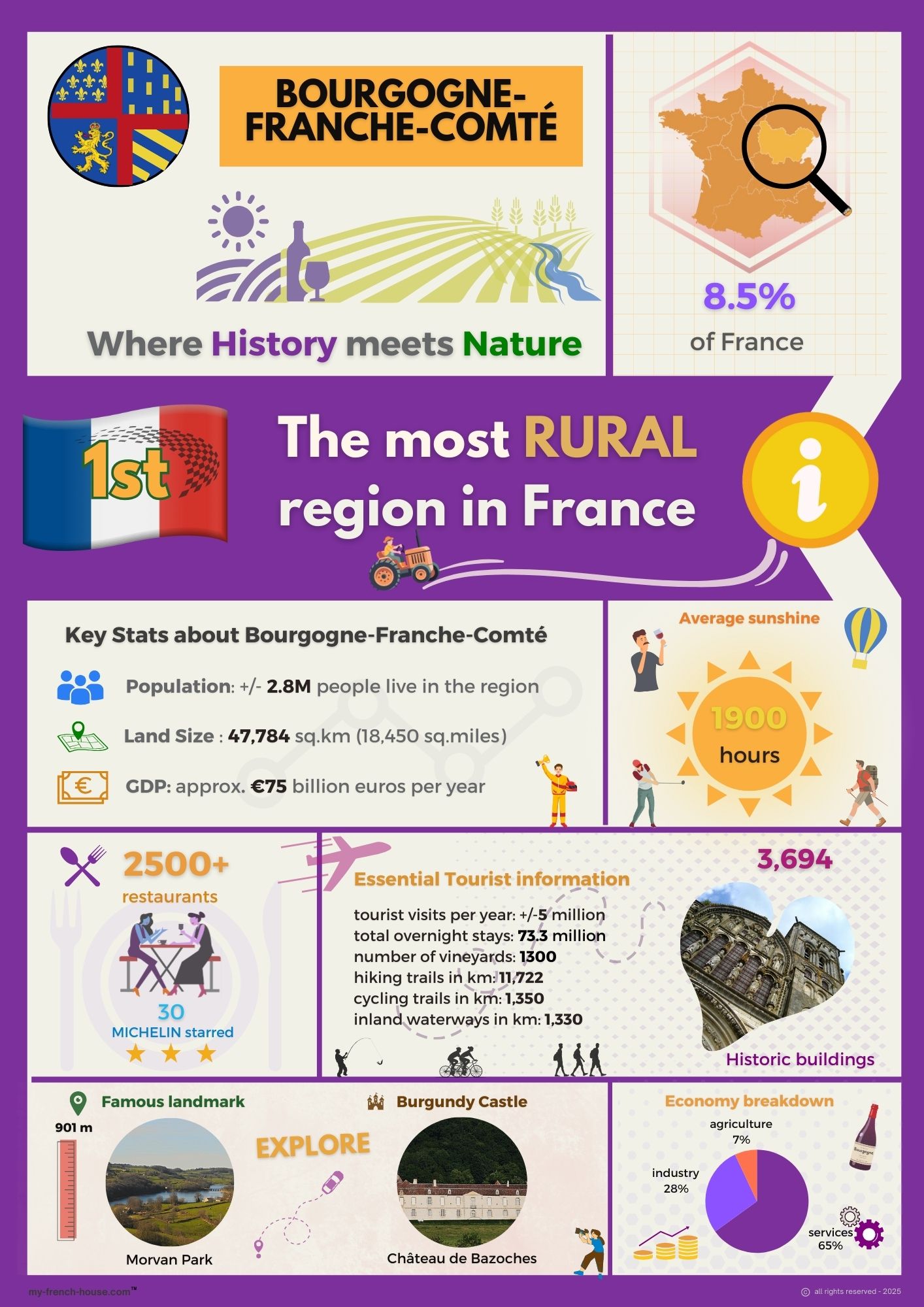
Learn more facts about the region with our infographic below. Click on the links on this page to discover a specific department and browse our properties for sale in Bourgogne-Franche-Comté.
Uncover the essentials of Bourgogne-Franche-Comté. This infographic is your visual cheat sheet, condensing key facts, demographics, and crucial statistics about the wine heartland of France.
Unlock Extra Images
Access additionalimages, save your favourite properties, compare them and set up alerts to stay informed about the market. The search for your dream French home starts here, ad-free.
 Search by Draw Map


 Unlock Extra Images
 6 Beds
 0.75
ha
0.75
ha  3 Baths