 Search by Draw Map


Monthly Newsletter
Sign up for our monthly newsletter today…

Nouvelle-Aquitaine comprises the former regions of Aquitaine, Charente, and Limousin, which have merged into a new super-region. Think of it as ‘the Southwest by the Ocean’, bordered to the south by the Pyrénées Mountains and to the west by the Atlantic coast.
The Nouvelle-Aquitaine region comprises 12 departments, including the Gironde, Dordogne, Charente, Lot-et-Garonne, and Pyrénées-Atlantiques, each with its own traditions, culture, and history. The capital of Nouvelle-Aquitaine is Bordeaux; other major cities include Périgueux, Bergerac, Limoges, Angoulême, Agen, and Pau.
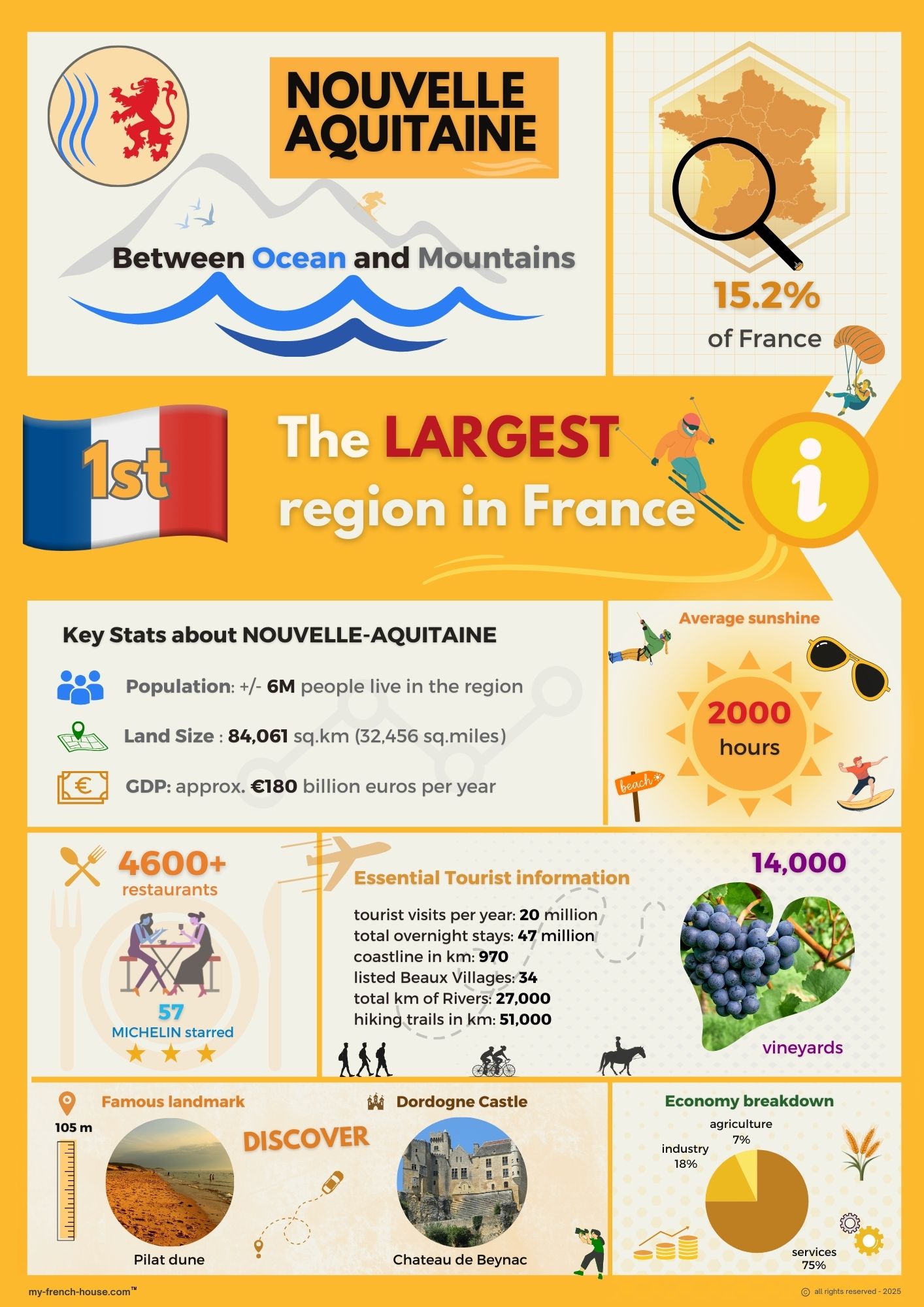
Nouvelle-Aquitaine has a temperate oceanic climate with mild winters, warm summers, and four distinct seasons. Influenced by the Gulf Stream, the Atlantic Ocean, and the southern mountains, it is somewhat damp but receives 2,000-2,200 hours of sunshine annually.
Coastal plains (from the Charente to Landes) are mild (5°C in winter, 22°C in summer) with strong sunshine, while the Basque Country receives more rain. The Limousin has colder winters with frost, and the Pyrénées have a mountain climate with snow in most winters. The region's sunny summers and mild winters make it ideal for year-round relaxation and outdoor activities.
Nouvelle-Aquitaine is a prime destination for Europeans and Americans seeking to relocate to France, boasting beautiful beaches along the Atlantic coast and stunning peaks in the wide Pyrénées mountain range.
The region features multiple UNESCO World Heritage sites, including the prehistoric Lascaux caves, as well as medieval castles and fortresses scattered across the landscape. Visitors can explore ancient Roman ruins, wander through charming medieval towns, and delve into the area's rich historical heritage.
It is famous for the Pyrénées, its superb food, local wines and specialities, gentle pace of life, stunning properties, beaches perfect for surfers, rugby history, classic Tour de France climbs for cycling enthusiasts, golf courses and mountains for skiers or hikers, all accessible thanks to a choice of international airports (Bergerac, Bordeaux, Brive...) and train stations.
Whether you want to surf, visit historic villages, or enjoy top-tier cuisine, this charming region offers something for everyone.
The meandering Dordogne River is a haven for sports and outdoor enthusiasts, surrounded by deep gorges and rapids that offer endless opportunities for hiking, kayaking, canoeing and playing golf. Along the river, traditional Périgourdine houses sit beneath golden cliffs.
La Roque-Gageac is a beautiful place to visit, thanks to its exotic palms and cacti that thrive on the gorge face. In Charente, Barbezieux-Saint-Hilaire provides many opportunities to explore the countryside. For instance, La Voie Verte, a former railway line converted into a greenway, passes through the town and is perfect for walking or cycling.
The Nouvelle-Aquitaine region also extends across the Pyrénées-Atlantiques, where visitors can enjoy even more outdoor adventures; the possibilities are almost endless.
The region is renowned for its delicious lamb, sourced from hillside flocks in the Pyrénées, often used in stews made with seasonal produce such as wild mushrooms from Périgord and fresh vegetables from Landes, Gers and Lot-et-Garonne.
The Basque Country is renowned for its seafood, and the region has plenty of restaurants that serve fish from the Bay of Biscay, oysters from Arcachon, lobster in Capbreton, the famous foie gras, and locally made hard and soft ewe’s milk cheeses.
Nouvelle-Aquitaine is both a popular tourist destination and a booming economic region. It is impossible to talk about this area, home to Bordeaux, Cognac, Pomerol, Saint-Émilion, and Margaux, without highlighting its famed wine culture. The village of Saint-Émilion, with its colourful vineyards, has a rich winemaking history.
Vineyards along the Garonne River produce wines from Bordeaux, including Médoc, Sauternes, and Bergerac. The region is also home to numerous independent growers and vast vineyards that produce and export exceptional wines and spirits worldwide.
The region is a hub of innovation and technology, with many startups and research centres driving its lively economy. Merging traditional industries with modern innovation makes Nouvelle-Aquitaine a thriving place to live and work. Review the facts below to better understand the regional economy.
Nouvelle-Aquitaine is more than just a beautiful destination; it’s a region where the past and beautiful landscapes come together to offer an unparalleled lifestyle. Here, old market villages meet lively cities. Whether you’re exploring medieval fortresses or indulging in local delicacies, every corner invites you to enjoy "la belle vie" in southwest France.
The main cities are Bordeaux, Pau, Limoges, La Rochelle, Poitiers, Bayonne, Biarritz, and Angoulême. You can reach them by road (motorways, national and departmental roads), by train, or by air. Here's a list of the region's airports and main train stations.
Nouvelle-Aquitaine blends tradition and modernity, offering the perfect mix of adventure and relaxation. It’s an ideal destination for those craving charm, space, culture, sports, entertainment, delicious cuisine, wines, and the welcoming warmth of southwest France.
To learn more about the region, check out our detailed infographic. Click on the links on this page to explore a specific department and browse our properties for sale in Nouvelle-Aquitaine.
 Unlock Extra Images
 7 Beds
 0.42
ha 4 Beds
0.42
ha 4 Beds 1 Bath
0.11
ha 1 Bed
1 Bath
0.11
ha 1 Bed